
Murfreesboro City Directory Collections at TSLA
The documented Murfreesboro historical-directory lead is narrow but useful. An MTSU repository bibliography identifies volumes for 1925, 1950, and 1956 at the Tennessee State Library and Archives in Nashville. The TSLA city-directory holdings page is the place to confirm the location, call number, and nearby Tennessee holdings before a visit or request. It is not safe to treat those three years as a continuous annual run. Neither a full local run, publisher sequence, nor a confirmed reverse-directory sequence was located in the official research.
| Directory resource | Documented years or scope | Keeper | How it helps |
|---|---|---|---|
| Murfreesboro historical directories | 1925, 1950, 1956 | Tennessee State Library and Archives, Nashville | Name, street, and household leads; inspect each edition's format |
| Genealogy and microfilm collections | Local and county materials | Rutherford County Library System Historical Research Center | Books, periodicals, microfilm, scanners, and staff-guided research |
| Rutherford Archives series | Series-specific historical records | Rutherford County Archives | Tax books, maps, newspapers, wills, marriages, and research files |
| Local newspaper holdings | Titles and runs vary | HRC and library collections | Obituary, event, address, and family-context corroboration |
Start with TSLA for one of the known directory years. If a name falls between those snapshots, ask the Historical Research Center about microfilm, telephone books, a street section, and adjacent editions. The local request is more productive when it names the surname, approximate year, and a possible street. Note: A directory listing is a research lead, so preserve its edition year and page with every transcription.
Documented Murfreesboro City Directory Years
The 1925, 1950, and 1956 known Murfreesboro volumes are anchors for a search, not a promise of coverage between them. Directories were commonly compiled at irregular intervals, and their arrangement can differ by edition. The Library of Congress notes that such volumes may have alphabetical names, addresses, occupations, spouses, and sometimes an address or telephone arrangement. A surname that appears in 1925 and 1950 could represent the same household, a related household, or an unrelated person with the same name. Dates and address details do the sorting.
- Write down the known surname, initials, a likely street, and an approximate year.
- Check the nearest documented Murfreesboro volume and copy the page citation exactly.
- Compare the next known edition for a changed street, spouse marker, initials, or business description.
- Ask TSLA or HRC whether an intervening volume, telephone book, or street arrangement survives.
Publication patterns, publishers, and the last printed Murfreesboro edition were not established in the source set. That uncertainty matters. It keeps a missing entry from being mistaken for proof that a person left town, died, or was never present.
Murfreesboro Directory Clues in Local Indexes
RCLS identifies city birth records from 1881 through 1915 and city death records from 1872 through 1923. Those local series can add a parent, date, or family clue when an older directory entry gives only initials and a street. Rutherford County Archives also lists marriage indexes for 1804 through 1888 and 1889 through 1940, along with wills from 1804 through 1899 and 1900 through 1947. Each is a separate record series with its own access path and limits.
Use an index result to form a precise Archives or HRC request, not as a final identity claim. A death date can distinguish two people with a shared name, while a marriage or will may supply a spouse, heir, or family connection. Certified-record access follows its own Tennessee rules, so an older local index should not be confused with an unrestricted certified-copy request.
Murfreesboro Directory Research at HRC
The Rutherford County Library System’s genealogy resources point researchers to local indexes, newspapers, microfilm, and library databases. Its Historical Research Center works alongside the Archives at 435 Rice Street in Murfreesboro. HRC resources include books, periodicals, scanners, and access routes for Ancestry Library Edition, Newspapers.com, and FamilySearch Affiliate material. That makes it a practical stop after a historic volume supplies an address but before a conclusion is drawn about a family connection.
RCLS genealogy resources identify the Murfreesboro city-directory and local-history collections available for follow-up.

Library and Archives staff can help identify the right reel, book, or index, but a request should still give a narrow date range and exact spelling. RCLS also identifies city birth records from 1881 to 1915 and city death records from 1872 to 1923, useful companion clues when a directory name needs a family or date check.
The two local access channels complement one another. The Archives asks researchers to call, email, or visit for its historical series. HRC provides genealogy assistance and local databases. Give either desk the surname, a date range, the street if known, and the type of record sought. Ask whether the result is an index, an original image, a microfilm reel, or a published volume. That distinction helps preserve the citation and shows what still needs to be verified in another source.
Ask for the format first. Request the edition, an alphabetical name section, a reverse or street section if one exists, and the reproduction rules. A reverse Murfreesboro run was not confirmed, so the staff question matters.
Reading Murfreesboro City Directory Entries
A historic Murfreesboro listing should be read as a small inventory of clues. Official online sources did not provide a digitized local page for transcription, so the following fields reflect the Library of Congress directory format rather than a made-up Murfreesboro sample. Copy the introduction and abbreviation key from the actual volume before expanding a shortened word. The edition, page, and repository call number are as important as the visible name.
| Headword | Surname with given name or initials, copied exactly as printed |
|---|---|
| Residence | Street number and street spelling, plus any address-section pointer |
| Household clue | Spouse or household marker when the edition prints one |
| Occupation or business | Description only when the volume includes it |
| Edition evidence | Year, page, library or TSLA call number, and any telephone notation |
- Criss-cross directory
- A directory arranged by street address rather than by surname. Ask whether a Murfreesboro edition includes one before assuming it does.
- Householder index
- An alphabetical name arrangement that points to a household or residence entry.
- Abbreviation key
- The volume’s explanation of shortened labels and symbols, usually near the front. Photograph or note it with the entry.
Do not convert an address entry into an ownership claim. The resident, a mailing contact, and the recorded owner can be different people. For a present-day parcel trail, use the Murfreesboro address directory workflow instead of stretching a historic listing beyond what it says.
Murfreesboro Newspapers Beside Directories
Newspapers make the directory gaps more manageable. The Archives lists Daily News Journal bound volumes and microfilm from 1931 through 1992. RCLS also identifies Rutherford Courier from 1931 through 2005, Carrier’s Courier from 1949 through 1968, Morning Press and Murfreesboro Press from 1978 through 1983, and Murfreesboro Post from 2006 through 2018. Search the title nearest the directory year for an obituary, wedding notice, civic event, public notice, or address-change clue.
Keep the newspaper title, date, page, and type of item in the notes. An obituary may clarify family relationships; a public notice may connect a name with a parcel; neither substitutes for the directory or a recorded instrument. Exact obituary-index coverage was not located, so ask HRC for the relevant title and date range instead of assuming one database covers all years.
First Families in Murfreesboro Directory Research
The First Families of Rutherford County program is a deep-lineage resource, not a current resident index. Its application calls for proof through each generation and recognizes evidence such as county records, federal census material, newspapers, family histories, marriages, births, obituaries, and death certificates. When an older directory surname matches a historic Rutherford family, the roster can suggest sources to inspect at HRC. It does not establish that a modern household belongs to that line.
The First Families program provides the source material for a Murfreesboro historical-directory companion search.
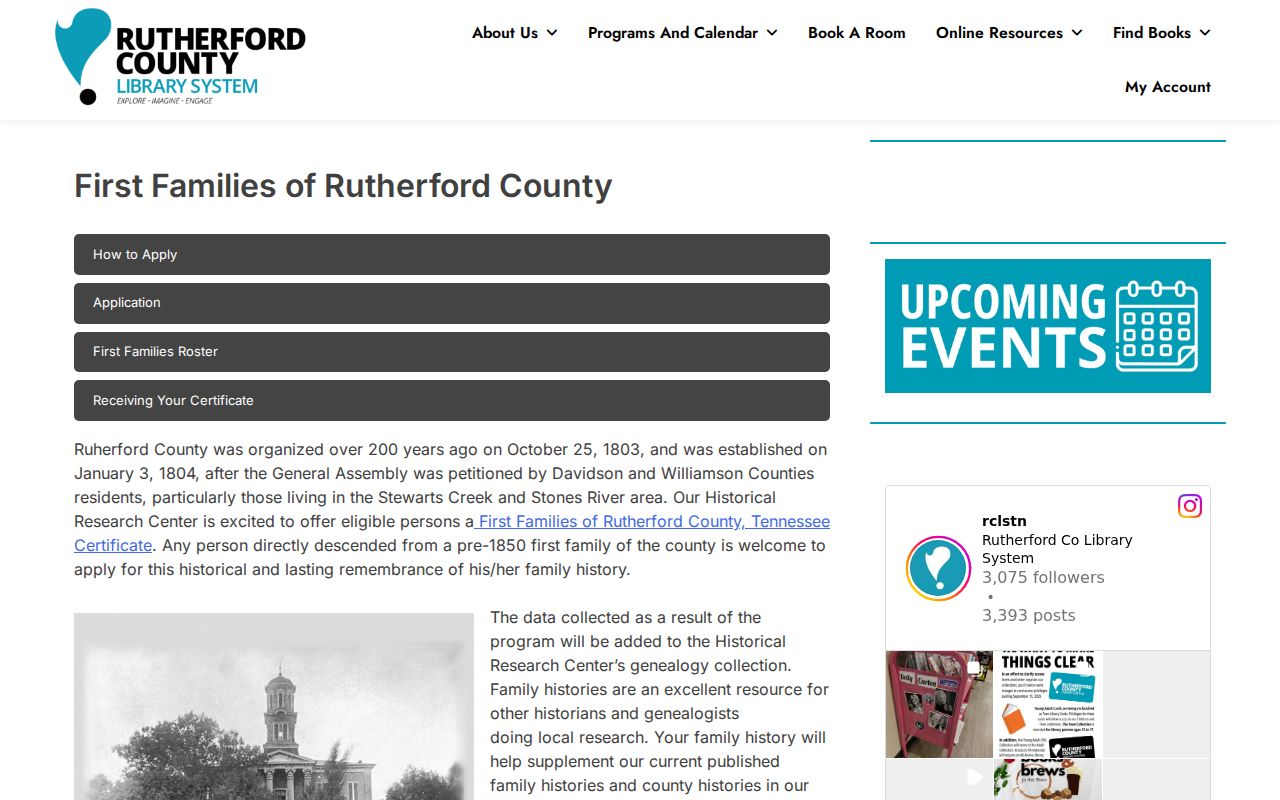
Use a directory entry to make a focused question, then test it with the program’s cited evidence and the relevant local record. This protects a family-history search from treating a shared surname as a proven relationship.
Tracing Murfreesboro Directories by Household
Directories can bridge the long interval between federal census releases. Begin with an exact entry in one documented year. Follow the surname, initials, spouse marker, and address through the next known edition, then pair that dated address with the appropriate census, tax record, deed, or newspaper item. Federal census schedules follow a 72-year public-release rule, so the available census year may not match the date a family needs. The dated directory still supplies a useful point between census snapshots.
- Locate the first known Murfreesboro directory appearance and record the entire entry.
- Compare 1925, 1950, and 1956 only where the person’s age, initials, spouse, or street make the match plausible.
- Check a street arrangement if the repository confirms one, then note nearby addresses without assuming kinship.
- Pair the result with a released census, the Archives tax series, or a deed when the question turns to a property.
- Use newspapers, wills, marriages, or death indexes to test a disappearance or a changed household.
A missing name has several explanations: the edition may not cover the year, the person may be indexed under initials or a married name, the address may differ, or the household may have moved. Keep the uncertainty visible until a second dated source resolves it. Note: The Historical Research Center and Archives are the documented fallback when an online search does not expose the needed volume.